By 2011, Febreze had achieved remarkable success, joining P&G’s Hall of Fame as the 24th brand to generate $1 billion in global sales. Yet behind this milestone lurked a critical problem: the brand was losing its competitive edge. Sales had dropped nearly 10 points over three years, competitors Glade and Air Wick had replicated Febreze’s advertising approach, and consumers could no longer distinguish between the brands. What followed was a textbook example of how proper diagnosis leads to breakthrough marketing effectiveness.
The commoditization crisis
Febreze faced the classic marketing challenge where points of differentiation had become points of parity. Research revealed a disturbing reality: consumers were more likely to think Febreze advertisements came from competitors than from Febreze itself. This advertising indistinguishability was particularly damaging since Febreze commanded premium pricing in a category where all brands were now perceived as equivalent.
Even worse, Febreze had lost ownership of its core brand attribute. The “odor elimination” benefit that traditionally belonged to Febreze was now equally associated with Air Wick and Glade in consumers’ minds. For a premium-positioned brand, this meant competing solely on price, which is a losing proposition.
The P&G diagnosis framework
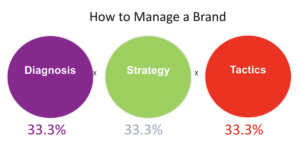
Rather than rushing into tactical fixes, P&G applied its legendary brand management expertise, returning to fundamentals: proper diagnosis before strategy, strategy before tactics. The team deployed a comprehensive research methodology that became a model for effective brand rehabilitation.
Qualitative research deep dive
P&G began with focus groups that revealed two crucial insights: a “welcoming home” remained the primary goal for target customers, and reactions to bad smells were far stronger and more emotive than positive reactions to good smells. This asymmetry would prove central to the eventual strategy.
In-home interviews provided ethnographic understanding, uncovering the powerful insight that “a messy home can still be clean, but a smelly home can never be clean”. One participant captured this perfectly: “When you walk into an unappealing room, you can close your eyes, but you can’t turn off your nose”.
Deprivation research, removing Febreze from loyalists and forcing them to use competitors, revealed what customers valued most about the brand. Meanwhile, loyalist research pitted brand advocates from all three major brands against each other to understand emotional drivers and barriers to switching.
Quantitative validation
Shop-along studies confirmed that consumers perceived all three major brands as identical and that each had “broken promises” to customers, eroding trust in category claims. Brand tracking quantified the loss of the odor elimination attribute, while pre-testing validated strategic direction before execution.
The strategic response
The comprehensive diagnosis yielded a clear strategic framework targeting 25-65-year-old mothers who wanted assurance that their homes were clean and fresh. The positioning: “Febreze makes even the filthiest place smell nice, no matter what they look like”, focusing on malodor removal rather than pleasant scent addition.
Two core marketing objectives emerged: reclaim ownership of odor elimination and achieve 71% brand attribution for new advertising (compared to the previous confusion, where consumers couldn’t identify Febreze ads).
The breakthrough campaign
The resulting campaign became one of the most famous and iconic advertisements of the decade. Set in apparently smelly environments, blindfolded consumers were asked to identify their location based on scent alone. The genuine surprise when they discovered they were in places like garbage dumps or dirty restaurants, yet smelling pleasant floral scents, provided compelling proof of Febreze’s effectiveness.
The campaign extended across multiple touchpoints. YouTube videos proved these weren’t actors but genuine experiments, Facebook engaged fans to nominate their “smelliest things,” and clever sponsorship aligned with America’s smelliest events, from Solstice yoga in Times Square to California’s Gilroy Garlic Festival. Every element connected back to the point of purchase, linking awareness to conversion.
Spectacular results
The campaign delivered on both strategic objectives with precision. For the first time, Febreze achieved dominant brand attribution while competitors continued struggling with recognition. Among consumers who saw the new advertisements, 84% attributed odor elimination to Febreze rather than competitors—reclaiming the brand’s core differentiator.
Sales rebounded significantly, and the campaign earned multiple Effie awards, though Mark Ritson noted it deserved even greater recognition. The success validated P&G’s methodical approach and became a benchmark for brand turnaround strategies.
Key lessons
Diagnosis before prescription
Like visiting a doctor who immediately prescribes chemotherapy without examining the patient, jumping to marketing tactics without understanding the problem leads to wasted resources and missed opportunities. P&G’s investment in comprehensive diagnosis, using multiple research methodologies, provided the foundation for an effective strategy.
Qualitative drives quantitative
The campaign’s success stemmed from using qualitative methods to understand underlying issues, then quantitative research to measure magnitude and causality. This sequential approach ensures strategies address real consumer needs rather than assumptions.
Loyalist research reveals hidden value
Understanding why current customers love your brand often uncovers differentiating factors that can be amplified. Febreze’s loyalists provided crucial insights that informed both positioning and creative execution.
Multiple research methods triangulate truth
No single research method provides a complete understanding. P&G’s approach, combining focus groups, ethnography, deprivation studies, shop-alongs, brand tracking, and pre-testing, created a comprehensive view that individual methods couldn’t achieve.
Febreze’s turnaround demonstrates that even billion-dollar brands can lose their way when competitive dynamics shift. However, brands with strong diagnosis capabilities, strategic patience, and execution excellence can not only recover but also emerge stronger than before. The key lies in resisting the temptation to jump immediately into tactics and instead investing in understanding the true nature of the challenge before crafting solutions.