For years, marketers have been told that the path to brand growth is relatively simple: make the brand more salient.
Increase the number of people who think of it in relevant buying situations. Build mental availability. Make the brand easy to find and buy. Then wait for penetration and market share to follow.
There is a lot of truth in this idea.
But according to Kantar’s analysis of BrandZ data, salience is not the whole story. Brands also need to be meaningful and different if they want to grow consistently.
Salience is only the beginning
The Ehrenberg-Bass Institute defines mental availability as the probability that a brand comes to mind when consumers experience a particular need or buying occasion.
Physical availability is the other side of the equation. It describes how easy the brand is to buy, whether that means finding it on a supermarket shelf, booking it online or accessing the relevant service.
These two forms of availability are essential. A brand cannot be chosen if consumers do not think of it, and it cannot be bought if it is difficult to find.
Kantar’s BrandZ analysis confirms the relationship between salience and usage. Across more than 5,000 brands measured over a three-year period, most brands that increased their claimed buying by more than five percentage points also improved their salience. Most declining brands lost salience.
This is why Kantar’s earlier research identified building exposure as the most important driver of long-term growth.
However, salience alone does not guarantee a sale.
If it did, every famous brand would grow indefinitely. Yet many highly recognisable brands lose market share over time. Being known is not the same as being chosen.
Meaning and difference matter
Kantar evaluates brands through three dimensions:
- Meaningful: The brand is functionally relevant and emotionally attractive.
- Different: The brand is perceived as unique or as setting trends in its category.
- Salient: The brand comes readily to mind in relevant situations.
The strongest brands combine all three.
A brand can be famous but irrelevant. It can be relevant but interchangeable. It can be distinctive but unavailable. Growth depends on bringing these qualities together in a way that matches the brand’s starting position.
That last point is important.
There is no universal formula that says every brand should invest in exactly the same weakness or follow the same sequence of actions.
Different starting points, different recipes
Around 25 percent of the brands that grew in Kantar’s analysis increased their salience relative to competitors without materially changing their existing profile of meaning and difference.
These brands were already perceived as meaningful and different. Their task was mainly to make their existing promise more visible and easier to choose.
The group included Amazon, WeChat, Wardah, Aldi and Uniqlo. These brands did not necessarily need a new positioning. They needed to amplify what they already stood for.
For other brands, salience was not enough.
Brands that were already salient but lacked meaning grew by improving their relevance and emotional appeal. This group included Holiday Inn, Zara and Yili dairy products.
Brands that were perceived as different but lacked meaning also invested in relevance. The iPhone, Yunnan Baiyao toothpaste and Airbnb belonged to this group.
Brands that were meaningful but lacked differentiation worked on becoming more distinctive while also increasing salience. Samsung, Adidas and Estrella Galicia beer were examples.
Finally, roughly one in five growth brands started without a clear strength and improved meaning, difference and salience simultaneously.
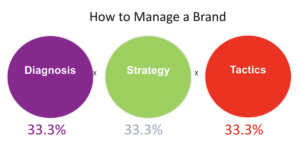
The lesson is straightforward: growth strategy should begin with diagnosis.
Diagnose before prescribing
Marketers often reach for a familiar solution before identifying the actual problem.
A brand loses share, so the team increases media spend. A competitor becomes more visible, so the brand launches a louder campaign. Sales decline, so the business introduces promotions.
Sometimes these actions are appropriate. But they may treat the symptom rather than the cause.
Imagine a brand with strong salience but weak meaning. Consumers know it, but they do not see it as relevant or attractive. More advertising may make the brand even more familiar, but familiarity will not solve the underlying problem.
Likewise, a meaningful brand that lacks differentiation may be liked but easily substituted. Consumers may appreciate its category, values, or benefits while choosing another brand at the point of purchase.
The correct question is not simply:
How can we make this brand more visible?
It is:
What is preventing this brand from being chosen more often?
That question leads to a better strategy.
The danger of a perception gap
Kantar’s analysis also highlights the relationship between attitudes and behaviour.
The research does not prove that improved salience or stronger associations directly cause growth. It is possible that more people first bought an unfamiliar brand and developed positive associations afterwards.
Nevertheless, the data shows a clear pattern: brands are more likely to grow when positive attitudes and behaviour move together. When there is a gap between what people think about a brand and how often they buy it, the brand is more likely to decline.
This distinction matters because brand metrics can create false confidence.
A brand may score well on awareness but poorly on consideration. It may be seen as different but not relevant. It may be regarded as meaningful but be difficult to buy.
Looking at a single metric can hide the real weakness.
Brand health should therefore be examined as a connected system:
- Can people recall the brand?
- Do they associate it with relevant needs and occasions?
- Do they see a reason to choose it?
- Is it meaningfully different from alternatives?
- Can they easily find and buy it?
- Does the customer experience support the promise?
Only then can marketers understand whether the brand is ready to convert salience into growth.
What declining brands teach us
The declining brands in the analysis reveal the reverse pattern.
Thirty-four percent had no major weakness at the beginning of the period but subsequently lost ground on meaning, difference and salience. This often happened when a strong, well-differentiated competitor entered or strengthened its position.
Another 28 percent were already weak on differentiation and later declined on meaning and salience as well.
A further 13 percent were weak on both meaning and difference before salience began to fall.
These findings offer an important warning.
Salience is not always the first problem. Sometimes it is the consequence of deeper weaknesses.
When a brand stops being relevant or distinctive, consumers gradually stop thinking about it. Media investment may slow the decline, but it cannot permanently compensate for a weak proposition or an undifferentiated brand.
There is no one-size-fits-all strategy
The analysis challenges a simplified version of the “build salience” argument.
Yes, brands need to be remembered. They need to appear in the minds of buyers across relevant category entry points. They also need to be easy to access and buy.
But when consumers think of the brand, the associations that come to mind matter too.
Is the brand relevant? Is it emotionally attractive? Is it genuinely different? Does it offer a credible reason to choose it over competitors?
The strongest brands are not merely famous. They are meaningful, different, and salient.
The practical implication for marketers is clear:
- Measure the brand over time, not at a single point.
- Compare its performance with competitors, not only with its own previous results.
- Identify the specific weakness limiting growth.
- Invest in salience, but do not assume salience can repair every problem.
- Make sure the customer experience delivers on the brand promise.
- Use distribution and availability to turn intention into purchase.
Brand growth is not achieved by making the same investment louder every year.
It comes from understanding what the brand already owns, identifying what it lacks and building the missing strength without sacrificing the assets that made the brand valuable in the first place.
Being remembered is essential.
But to be chosen, a brand must also mean something and stand for something distinctive.
Original resource
Brands need to build more than just salience to grow by Kantar.